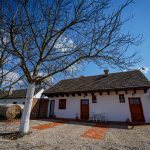
The salaš is 50 minutes from Belgrade and five minutes from the E70 motorway exit.…
Sirmium and Sremska Mitrovica in a day: a Roman capital and lunch at the salaš
Sremska Mitrovica is ancient Sirmium — one of the four capitals of the Roman Empire and the birthplace of several Roman emperors. The town lies on the official cultural route “The Roman Emperors Route” (Itinerarium Romanum Serbiae), and Salaš “Isailovi” is 5 km from its centre. Which means that the Roman past of the town and a Srem lunch can fit into the same day, without long transfers between the two.
Let us be clear straight away: we are a salaš, not a travel agency. We neither organise nor guide the tour of Sirmium. This page exists because groups ask us regularly how to put the town and the salaš into one programme, so we have written down what we know reliably about it. For the tour of the town, for the current opening hours of the sites and for guides, contact the Tourist Organisation of the City of Sremska Mitrovica.
Why Sirmium matters at all
In the time of the tetrarchy the Roman Empire had four capitals, and Sirmium was one of them. It was not a provincial town on the margins but an administrative and military centre from which a good part of the empire was governed, in a strategic position on the Sava and on the road to the Danube frontier.
Several Roman emperors came from Sirmium and its surroundings; the best known among them is Probus, whose name the town still carries today through all sorts of institutions and events. For a visitor, one consequence of that history matters most: the Roman layer is not somewhere outside the town but underneath it — today’s Sremska Mitrovica is built over Sirmium, so the archaeology sits in the very centre and not at a site out in the countryside.
What there is to see in the town
The basis of every visit is two places in the centre:
The Imperial Palace
An archaeological site with the remains of the imperial residence, roofed over and laid out for visitors, right in the centre of the town. It is the point at which you see most clearly what Sirmium was.
The Museum of Srem
The town museum, with an archaeological collection holding the finds from the sites. The museum and the site are visited together and follow on from one another naturally.
Beyond that, the town centre itself and the promenade along the Sava are pleasant for a short walk between two points of the programme. Opening hours and ticket prices change through the year and depend on the season and on whether you come as a group — check them before you set off, either directly or through the Tourist Organisation. For groups a guided tour is almost always better than walking round on your own, because the remains are hard to read without explanation.
How the salaš fits into a day like that
The most common running order we see with groups is a simple one: the town in the morning, the salaš in the afternoon. The tour of the Roman heritage takes as long as it takes, and then it is 5 km to the salaš — a short transfer, with no return to the motorway.
| The centre of Sremska Mitrovica → the salaš | 5 km |
|---|---|
| The E70 motorway exit → the salaš | 5 minutes |
| Belgrade → the salaš | about 50 minutes |
| Novi Sad → the salaš | about 55 minutes |
| Batrovci → the salaš | 30–45 minutes |
| Time the group spends at the salaš | 2–3 hours |
For groups already travelling the Zagreb–Belgrade corridor this is particularly convenient, because the turn off the route is a short one. Ready-made suggestions for days of this kind are described on the Group programmes page — the combination of Sirmium and a Srem lunch is Module 2 there. If you are setting out from Belgrade, the piece you want is A day trip from Belgrade.
A Roman sarcophagus at the salaš
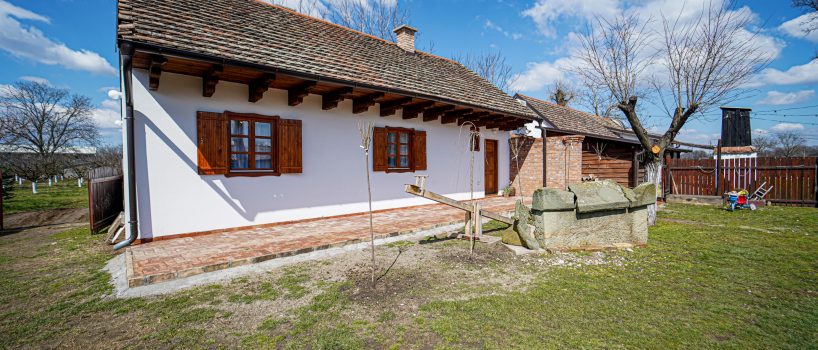
The Roman part of the day does not end in town. The salaš yard keeps the Star Sarcophagus — a complete Roman sarcophagus from Sirmium (3rd – early 4th century), found in 1990 in the eastern necropolis, registered with the Museum of Srem and published in 2026 by the Institute of Archaeology. The host shows it to the group before lunch; anyone who was in the museum’s lapidarium in the morning sees a relative of the same green stone here. What there is to see and how it fits the timetable: The Star Sarcophagus of Salaš Isailovi.
What there is to eat after a Roman capital
For a programme like this the usual choice is roast suckling pig from the brick oven, with crisp crackling, or a traditional Srem lunch — home-made noodle soup, boiled meat and vegetables, štrudla. For dessert there is baklava with poppy seed, sour cherries or walnuts, štrudla with poppy seed, walnuts or carob, and krofne (doughnuts) with jam.
The menu is agreed in advance and nobody orders at the table, because everything is prepared immediately before the group arrives so that it can be served hot. The whole choice of dishes is on the Food page, and what the ready-made group menus consist of on the Set menus for groups page.
The salaš itself was built in 1965 and is run by the Jovanović family — “Isailovi” is the family nickname, after an ancestor called Isailo, a priest from Greece who was given a parish in Sremska Mitrovica. For a group that spent the morning looking at an imperial palace, the afternoon rounds off the other face of this region: a Vojvodina household still run today by the same family. There is more about that on the About the salaš page.
Practical conditions
| How we work | By prior arrangement only, at least one day in advance |
|---|---|
| Minimum group | 25 people |
| Capacity | 80 seats indoors; up to 120 guests with the outdoor area |
| Parking | Free; two coaches at the same time or about 30–40 cars |
| Approach | Partly asphalt, the last stretch macadam of crushed stone; there is room for a coach to turn |
| Driver and guide | Do not pay for their meal |
| Toilets | Four, free of charge |
| Languages | English directly; German with a translator when needed |
| On request | Tamburaši or a wine tasting with a sommelier; the raised platform and the projector are at the salaš |
If the group is not travelling on the same day, there are three rooms at the salaš with two beds each — the details are on the Accommodation page. The other questions we are asked most often are gathered on the Frequently Asked Questions page.
How to get an offer
We need three pieces of information: the number of people, the date and the time of the meal. On that basis we send our prices and a suggested menu and fix the arrival time together. If you are preparing a programme for a catalogue, tell us how much space you have — we will send a description cut to length, in Serbian or in English.
Send us an enquiry: salas.isailovi@gmail.com or +381 65 5506929.
Salaš “Isailovi”, Rumski drum bb, Sremska Mitrovica — 5 km from the centre of ancient Sirmium.